由电阻、电感和电容组合而成的电路在工作时要从电源吸取功率,显然此功率与单一参数电路的功率是不完全相同的。本篇将三种元件组合成的电路作为一个无源二端网络讨论其功率,不涉及电路内部的组合方式,如右图所示。 设流入该二端网络的电流<span class="MathJax" id="MathJax-Element-1-Frame" tabindex="0" data-mathml="i=I2sinωt" role="presentation" style="display: inline; line-height: normal; letter-spacing: normal; word-spacing: normal; word-wrap: normal; white-space: nowrap; float: none; direction: ltr; max-width: none; max-height: none; min-width: 0px; min-height: 0px; border: 0px; position: relative;">i=I2√sinωti=I2sinωt,二端网络两端点之间的电压<span class="MathJax" id="MathJax-Element-2-Frame" tabindex="0" data-mathml="u=U2sin(ωt+φ)" role="presentation" style="display: inline; line-height: normal; letter-spacing: normal; word-spacing: normal; word-wrap: normal; white-space: nowrap; float: none; direction: ltr; max-width: none; max-height: none; min-width: 0px; min-height: 0px; border: 0px; position: relative;">u=U2√sin(ωt+φ)u=U2sin(ωt+φ),二端网络的等效复阻抗<span class="MathJax" id="MathJax-Element-3-Frame" tabindex="0" data-mathml="Z=|Z|∠φ" role="presentation" style="display: inline; line-height: normal; letter-spacing: normal; word-spacing: normal; word-wrap: normal; white-space: nowrap; float: none; direction: ltr; max-width: none; max-height: none; min-width: 0px; min-height: 0px; border: 0px; position: relative;">Z=|Z|∠φZ=|Z|∠φ。 瞬时功率二端网络在某瞬时吸收的功率称为瞬时功率,用符号p表示。 p=ui=U2√sin(ωt+φ)×I2√sinωt=UI[cosφ−cos(2ωt+φ)]p=ui=U2sin(ωt+φ)×I2sinωt=UI[cosφ−cos(2ωt+φ)]
从上式中可知,瞬时功率总是随时间而变化的,当p为正值时,表示二端网络从电源吸收功率;当p为负值时,表示二端网络向电源释放功率。 有功功率由于瞬时功率随时间不断地变化,工程上应用很不方便。在工程上常用的交流电路的功率是指有功功率,即取瞬时功率在一个周期内的平均值,又称为平均功率,并用P表示,有功功率的单位是W或kW。 P=1T∫0Tpdt=1T∫0TUI[cosφ−cos(2ωt+φ)]dt=UIcosφP=1T∫T0pdt=1T∫T0UI[cosφ−cos(2ωt+φ)]dt=UIcosφ
从上式可知,有功功率是一个不随时间变化的恒定值。因为二端网络中有电阻、电感和电容,而电感、电容是不消耗有功功率的,所以有功功率就是二端网络中电阻所消耗的功率。如日光灯的额定功率是40 W,就是指日光灯等效电路中电阻所消耗的功率是40 W。 上式表明有功功率不仅与电压、电流有效值的乘积有关,还和电压与电流相位差角φ的余弦函数有关。式中的cosφ为电路的功率因数,φ角也称为功率因数角。由于φ角是二端网络复阻抗的阻抗角,所以功率因数是由二端网络的参数和频率决定的。 无功功率在二端网络中,由于有电感、电容,它们虽然不消耗电能,但与电源之间有能量的交换。从前述单一参数交流电路中可知,对电感,有<span class="MathJax" id="MathJax-Element-6-Frame" tabindex="0" data-mathml="QL=ULI" role="presentation" style="display: inline; line-height: normal; letter-spacing: normal; word-spacing: normal; word-wrap: normal; white-space: nowrap; float: none; direction: ltr; max-width: none; max-height: none; min-width: 0px; min-height: 0px; border: 0px; position: relative;">QL=ULIQL=ULI;对电容,有<span class="MathJax" id="MathJax-Element-7-Frame" tabindex="0" data-mathml="QC=UCI" role="presentation" style="display: inline; line-height: normal; letter-spacing: normal; word-spacing: normal; word-wrap: normal; white-space: nowrap; float: none; direction: ltr; max-width: none; max-height: none; min-width: 0px; min-height: 0px; border: 0px; position: relative;">QC=UCIQC=UCI。故二端网络总的无功功率是全部电感和电容无功功率的代数和。应该注意到,在同一交流电流作用下,或在同一交流电压作用下,无论是并联还是串联电路,电感和电容瞬时功率的符号始终是相反的。在串联电路中电流<span class="MathJax" id="MathJax-Element-8-Frame" tabindex="0" data-mathml="I˙" role="presentation" style="display: inline; line-height: normal; letter-spacing: normal; word-spacing: normal; word-wrap: normal; white-space: nowrap; float: none; direction: ltr; max-width: none; max-height: none; min-width: 0px; min-height: 0px; border: 0px; position: relative;">I˙I˙是同一电流,但电压<span class="MathJax" id="MathJax-Element-9-Frame" tabindex="0" data-mathml="U˙L" role="presentation" style="display: inline; line-height: normal; letter-spacing: normal; word-spacing: normal; word-wrap: normal; white-space: nowrap; float: none; direction: ltr; max-width: none; max-height: none; min-width: 0px; min-height: 0px; border: 0px; position: relative;">U˙LU˙L和<span class="MathJax" id="MathJax-Element-10-Frame" tabindex="0" data-mathml="U˙C" role="presentation" style="display: inline; line-height: normal; letter-spacing: normal; word-spacing: normal; word-wrap: normal; white-space: nowrap; float: none; direction: ltr; max-width: none; max-height: none; min-width: 0px; min-height: 0px; border: 0px; position: relative;">U˙CU˙C反相;并联电路中电压<span class="MathJax" id="MathJax-Element-11-Frame" tabindex="0" data-mathml="U˙" role="presentation" style="display: inline; line-height: normal; letter-spacing: normal; word-spacing: normal; word-wrap: normal; white-space: nowrap; float: none; direction: ltr; max-width: none; max-height: none; min-width: 0px; min-height: 0px; border: 0px; position: relative;">U˙U˙是同一电压,但电流<span class="MathJax" id="MathJax-Element-12-Frame" tabindex="0" data-mathml="I˙L" role="presentation" style="display: inline; line-height: normal; letter-spacing: normal; word-spacing: normal; word-wrap: normal; white-space: nowrap; float: none; direction: ltr; max-width: none; max-height: none; min-width: 0px; min-height: 0px; border: 0px; position: relative;">I˙LI˙L和<span class="MathJax" id="MathJax-Element-13-Frame" tabindex="0" data-mathml="I˙C" role="presentation" style="display: inline; line-height: normal; letter-spacing: normal; word-spacing: normal; word-wrap: normal; white-space: nowrap; float: none; direction: ltr; max-width: none; max-height: none; min-width: 0px; min-height: 0px; border: 0px; position: relative;">I˙CI˙C反相。所以,电路无功功率代数和为: Q=QL−QC=UIsinφQ=QL−QC=UIsinφ
cosφ=R|Z|sinφ=X|Z|cosφ=R|Z|sinφ=X|Z|
由此可得有功功率和无功功率分别为: P=UIcosφ=UIR|Z|=I2RQ=UIsinφ=UIX|Z|=I2X⎫⎭⎬⎪⎪⎪⎪⎪⎪P=UIcosφ=UIR|Z|=I2RQ=UIsinφ=UIX|Z|=I2X}
视在功率二端网络的总电压和总电流有效值的乘积称为视在功率,用符号S表示,即:<span class="MathJax" id="MathJax-Element-17-Frame" tabindex="0" data-mathml="S=UI" role="presentation" style="display: inline; line-height: normal; letter-spacing: normal; word-spacing: normal; word-wrap: normal; white-space: nowrap; float: none; direction: ltr; max-width: none; max-height: none; min-width: 0px; min-height: 0px; border: 0px; position: relative;">S=UIS=UI,视在功率的单位是伏安(VA),或千伏安(kVA)。
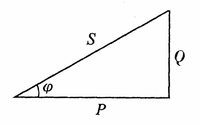
在工程上,常用视在功率来表示电气设备的额定容量,如变压器。电气设备的额定视在功率等于额定电压和额定电流的乘积,即<span class="MathJax" id="MathJax-Element-18-Frame" tabindex="0" data-mathml="SN=UNIN" role="presentation" style="display: inline; line-height: normal; letter-spacing: normal; word-spacing: normal; word-wrap: normal; white-space: nowrap; float: none; direction: ltr; max-width: none; max-height: none; min-width: 0px; min-height: 0px; border: 0px; position: relative;">SN=UNINSN=UNIN。例如,一台视在功率为10000kVA的发电机,当负载功率因数<span class="MathJax" id="MathJax-Element-19-Frame" tabindex="0" data-mathml="cosφ=1" role="presentation" style="display: inline; line-height: normal; letter-spacing: normal; word-spacing: normal; word-wrap: normal; white-space: nowrap; float: none; direction: ltr; max-width: none; max-height: none; min-width: 0px; min-height: 0px; border: 0px; position: relative;">cosφ=1cosφ=1时,能发出1000kW的有功功率,当负载功率因数<span class="MathJax" id="MathJax-Element-20-Frame" tabindex="0" data-mathml="cosφ=0.6" role="presentation" style="display: inline; line-height: normal; letter-spacing: normal; word-spacing: normal; word-wrap: normal; white-space: nowrap; float: none; direction: ltr; max-width: none; max-height: none; min-width: 0px; min-height: 0px; border: 0px; position: relative;">cosφ=0.6cosφ=0.6,电压、电流达到额定值时,它仅能发出6000kW的有功功率。 有功功率P,无功功率Q和视在功率S三者之间的关系为: P=ScosφQ=SsinφS=P2+Q2−−−−−−−√φ=arctanQPP=ScosφQ=SsinφS=P2+Q2φ=arctanQP
且三者也可以组成一个直角三角形,如图所示,此三角形叫做功率三角形。 若二端网络中含有多个不同功率因数的负载时,每个负载的视在功率分别以S1、S2、S3……表示,但总的视在功率:
在求总视在功率时,应分别求出总有功功率P和总无功功率Q,然后根据功率三角形再求出视在功率。即: P=P1+P2+P3+⋯Q=Q1+Q2+Q3+⋯S=P2+Q2−−−−−−−√P=P1+P2+P3+⋯Q=Q1+Q2+Q3+⋯S=P2+Q2
| 
 /1
/1 
 |手机版|免责声明|本站介绍|工控课堂
( 沪ICP备20008691号-1 )
|手机版|免责声明|本站介绍|工控课堂
( 沪ICP备20008691号-1 )

 发表于 2019-4-25 20:54:48
 提升卡
提升卡 置顶卡
置顶卡 照妖镜
照妖镜 发表于 2019-5-18 21:54:04